Wednesday, June 25, 2014

Gyoza, Tonkatsu, Foods on Sticks & Beer (It's a Trip Part 3.2)

What a day for food! And this post is all about just that, everything we consumed today. Last night we had an amazing Wagyu beef dinner at HAFUU, so today we were going for some other types of Japanese cuisine. Kyoto has a huge variety of food choices and we are going to take advantage on this trip! I'll go ahead and say it now, we are not concerned about the healthiness of our choices this week...

We started off today with hiking up Mt Inari at the Fushimi Inari Shrine. (Read about it and see a map of all today's destinations here: It's a Trip Part 3.0) We were starving when lunchtime rolled around. We rushed off to Kyoto Station to try some famous tonkatsu (fried pork cutlet). Japan has a couple great restaurant chains for tonkatsu (Tonkatsu Wako & Katsukura are a couple that I'd found) and Kyoto has locations for each of them. We were guaranteed to get some good quality fried pork! We chose Tonkatsu Wako, they have a location in Isetan Department Store in Kyoto Station, it's on the 11th floor in the "Eat Paradise" area. We each had a different set menu. Regardless of what you order, the soup, rice and cabbage are unlimited. I had 2 small pork filets and 2 crab croquettes. Keenan had a pork filet, 2 prawns, a cheese filled pork loin and an egg seafood custard. All of it was delicious! Well, maybe not the custard thing. I especially loved the light citrus dressing (yuzu sauce) for the cabbage!

Teeny clams in the miso soup.
Tonkatsu Wako.
Kyoto Station from the rooftop.
Grassy area on the roof of Kyoto Station, "Happy Terrace."
Careful Keenan!! 

After lunch we checked out Kinkakuji (Golden Pavilion), Ryoanji (rock garden), Ninnaji Temple and Arashiyama (bamboo forest). (Read about the afternoon here: It's a Trip Part 3.1) For dinner we decided to do a little variety, gyoza and foods on sticks!

Gold, Rocks & Bamboo (It's a Trip Part 3.1)

After a great morning hike and lunch of course, we continued on, ready to see the sites of northwest and west Kyoto. **you can see a map of today's locations in It's a Trip Part 3.0** At Kyoto Station we hopped on a bus headed toward the breathtaking Kinkakuji Temple "Golden Pavilion" also called Rokuonji. The Buddhist temple Kinkakuji was built in the late 1300's and has burned down several times since then, most recently in 1950. The current building was built in 1955. This beautiful temple is covered in gold leaf and is a famous symbol of Kyoto. It has also been named as a UNESCO World Heritage Site. This was absolutely the busiest place we visited on this trip. We stood waiting at least 5 minutes for the opportunity to snap a quick picture of me with the temple in the background. I would have loved to get a picture of both of us, but at the time it was not worth the hassle, it was crazy, we were hot, we moved on.

Kinkakuji is open every day from 9:00-17:00. Admission is ¥400.
GPS Coordinates: 35.040090, 135.729243


Next stop was Ryoanji Temple and its rock garden, the most famous in Japan. This was just a few minutes bus ride from Kinkakuji. The site became a Buddhist temple in 1450 but no one knows when the rock garden was created or what it's supposed to represent. There are several theories, but it is recommended to sit and meditate to find your own meaning. Fifteen rocks are arranged in the gravel filled rectangular garden, from any given angle it is impossible to see all the rocks at the same time. We didn't linger long enough to discover our own meanings in the garden. We thought maybe we could see all the rocks at one point, but we were also standing vs sitting like you would if meditating...so maybe we were cheating? Or what we thought was a separate rock was connected to another, who knows! There was no room for us to sit and ponder, the platform was full and it was in the afternoon sun. Again, we were hot and didn't stay long. Ryoanji and the gardens are a UNESCO World Heritage Site.
Ryoanji is open everyday, hours vary by season. Admission is ¥500.
http://www.ryoanji.jp/smph/eng/
GPS Coordinates: 35.035601, 135.718263

Pond within the grounds of Ryoanji.
Famous Zen rock garden.

Tuesday, June 24, 2014

10,000+ Torii Gates?! Fushimi Inari Shrine (It's a Trip Part 3.0)

Wow! Soooo much accomplished today! Crazy amounts of history and walking and food! It'll take me multiple posts to do it justice...

Fushimi Inari Shrine

Here's the map of Kyoto with today's points of interest. I planned our sightseeing based on my own research and on a Japanese friend's recommendations.


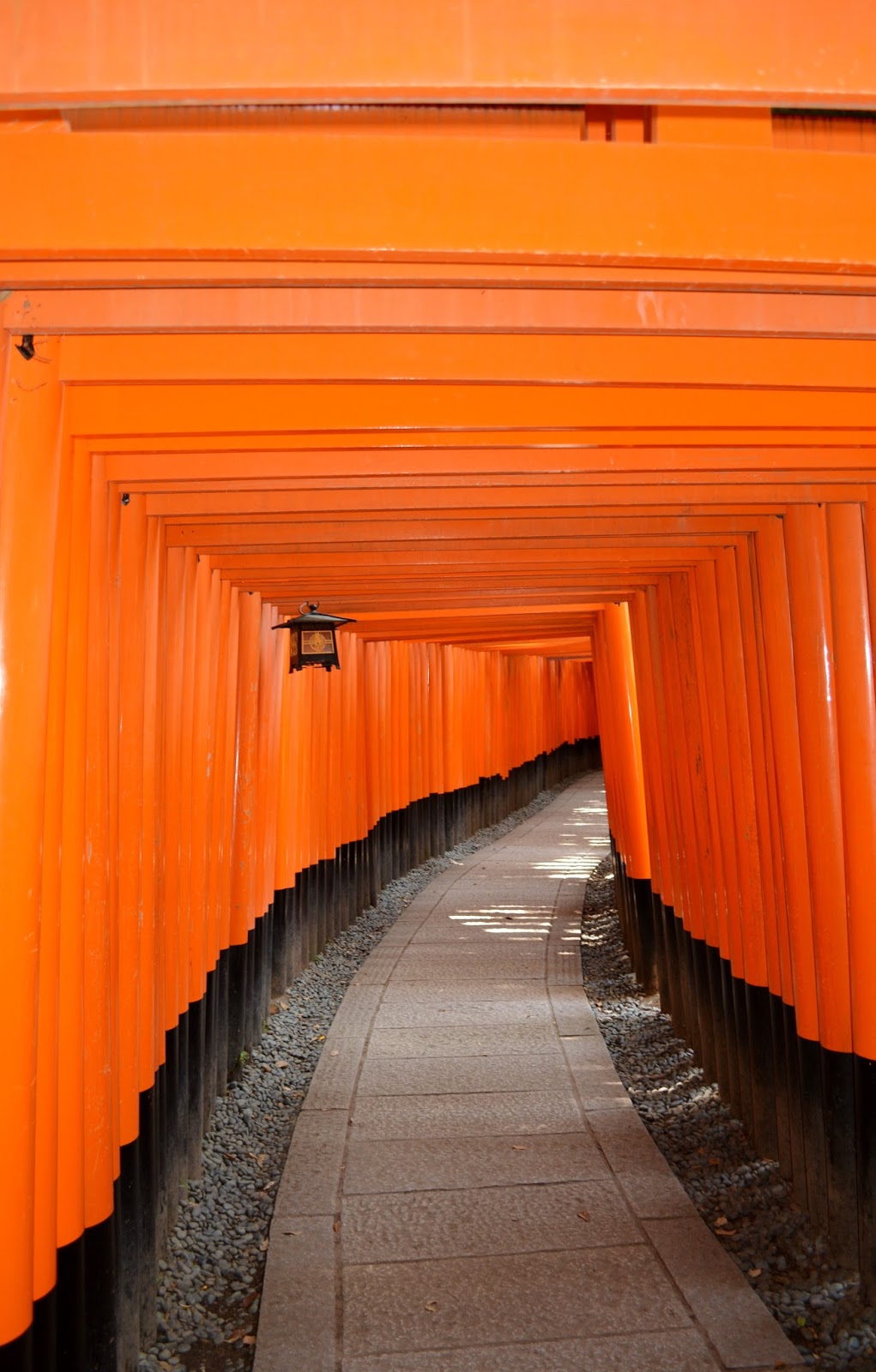
We started off the day by going to Fushimi Inari Taisha is the principle Inari shrine in Japan. Inari is the Shinto god of agriculture (very specifically rice) and business. Fushimi Inari is famous for its thousands and thousands and thousands of torii gates. I can't find an exact number, and no one probably knows for sure, but there are over 10,000 torii gates at this shrine. This shrine is sometimes referred to as 1,000 Torii Gate Shrine. Torii gates spanning the hiking trail are erected for donations by individuals and companies that vary from ¥400,000 to ¥1,000,000+ (that's $4,000-10,000+). Not sure how old this shrine is, but it existed before Kyoto became Japan's capital in 794.
The main hall can be seen from the Inari Station exit. From there we just followed the gates (and the crowds) up the mountain.
We had the subway/bus passes that I mentioned in a previous post so we utilized the subway to Kyoto Station and then paid for the train to JR Inari Station.
There is no charge to visit this shrine and it is always open.
http://inari.jp/
GPS coordinates: 34.968002, 135.772715


Yes we did eat our vegetables in the
Natural ideal style at breakfast!
Romon Gate, donated in 1589. 
Main Hall.

BEST STEAK EVER ? Wagyu Beef at HAFUU! (It's a Trip Part 2 .1)

HAFUU! When we decided to visit Kyoto I knew we'd also have to decide if we were going eat Wagyu beef. Apparently it wasn't a decision for Keenan...it was a "must do." This is a tricky post to write as we are both loyal to the Nebraska corn-fed beef we grew up on and still love. We feel like we know our steak. Until this point we have not had a single steak at any Japanese restaurant that's left us saying "that was amazing, we'd eat there again." Now that has changed...


You may have heard of Wagyu or Kobe beef. Kobe is just one "brand" of Wagyu beef, but it is most well known. There are very few restaurants in the United States that serve genuine Wagyu beef. Lots claim to have Kobe this or that, but it is a lie! Japan exports very little of their beef and the actual numbers vary from year to year. That 100% Kobe beef steak or hamburger you're getting at that place down the street? It's most likely not, as in 99% chance not. Yes, even at that chain Kobe Steakhouse, fake. Unfortunately the USA has no regulations on using the words Kobe beef, so anyone can list it in their menu, genuine or not...ok rant over.

So what does it take in Japan for beef to be labeled Wagyu? Wagyu refers to limited meat brands with certain breeds of cattle raised using special methods. No, those methods don't include beer or massages, those are myths! One of the charactaristic features of Japanese Wagyu is the texture. The fat is woven finely throughout the muscle, called marbling. The marbling creates a tenderness that feels like each bite melts in your mouth. Wagyu beef is also high in unsaturated fats that melt at a lower temperature than saturated fats, temperatures even lower than the human body temperature. Thus making it literally melt in your mouth.

USDA Choice vs A5 (highest grade of Wagyu) marbling.
Photo from: http://insights.looloo.com/steaks-101-learn-different-grades-of-beef/

A couple very interesting articles about Wagyu beef:


The restaurant we went to, HAFUU, is owned by someone that has a meat shop more than 100 years old in Kyoto. This gives them access to high quality meat and the ability to sell it for a more reasonable price than some other places that sell Wagyu beef. We had a Japanese friend call to make reservations for us a couple days in advance...one more reason we were so nervous about catching that flight out of Sendai! They required a credit card for the reservation, and have a no-show charge. There are 2 areas of seating, the counter, which seats 16 and a back area that seats 20. We went with counter seats so we could watch the cooks. 
This dinner was definitely a splurge for us, but a potentially once in a lifetime opportunity! (A voice beside me is already saying that we MUST do it again before we leave Japan, so now...less potentially a once in a lifetime opportunity...)


The restaurant was on a mostly residential street.
It's just beyond the power pole on the right.
He's so excited!

We Made It! (It's a Trip Part 2 .0)

We arrived! After that close call in Sendai everything else went smoothly with our flight to Osaka (Kansai Int'l Airport) and our train to Kyoto! Details about our hotel and transportation are at the bottom of the post.

So why go all the way to Kyoto? To see temple after shrine after temple, eat some delicious food and hopefully get eyes on a real life geisha! And because it's on my list of "must-do's," we've been in Japan exactly 1 year as of today and that in itself is cause for a trip-celebration! But is it really a celebration? We've been here a year already?!? Yikes! It's going sooo fast, too fast!! We've gotta keep busy if we wanna see as much as possible in our time here, especially since we've got a deployment coming up for 2015! So getting back on track...Kyoto was the capital city of Japan from 794-1868. It is full of history, shrines and temples. It was spared air raids and an atomic bomb during WWII due to it's cultural and historical significance. 

After we got checked into the hotel we started exploring! I had somewhat of a plan for our days in Kyoto, some based on my own research and some based on suggestions from a knowledgeable Japanese friend.

Today we visited Toji Temple, Sanjusangendo and had an AMAZING dinner at HAFUU!

Yellow- Kyoto Station. Red- hotel (Sakura Terrace).
Blue- Toji Temple. Light Blue- Sanjusangendo.
Brown- HAFUU. Pink- Fishbowl.

First stop...Toji Temple "East Temple" was built when Kyoto became the capital city (around 794) and was one of two guardian temples of the Imperial Palace. It is a UNESCO World Heritage Site. Additional history, location and admission information (price varies by season) can be found at: http://www.toji.or.jp/en/about/index.html
GPS coordinates: 34.981558, 135.747467


Pagoda at Toji Temple, rebuilt in 1644, at
57 meters it is the tallest pagoda in Japan.
Nandaimon Gate of Toji Temple.
Keenan at Nandaimon Gate.